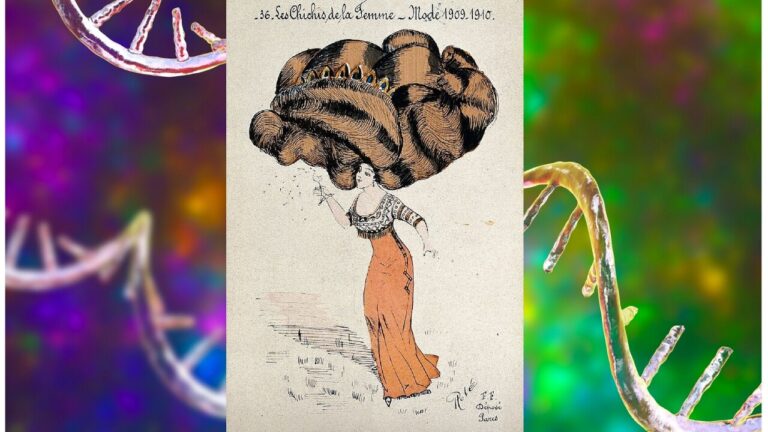
79. – A satirical postcard from Paris, 1909. A lady with an enormous hairstyle on a slender body in an orange dress. A joke about fashion? Yes — but also a precise map of protein RBM39 RRM2 (PDB: 7Q33). The combs in the hairstyle encode RNA. The zigzag on the dress — a branchless backbone. The embroidery on the neckline — side chains and atoms. The dandelion seeds — excised introns. Six independent matches on a single postcard, over a hundred years before this structure was solved.
Forgive and Draw Closer to God. St. Gabriel Urgebadze and the molecular cost of holding evil in your heart.
78. „Humility opens chromatin. Pride closes it. So does holding evil in your heart. A Georgian monk who burned Lenin’s portrait and lived in a chicken coop gave people a prescription that modern epigenetics confirms word for word. The second entry in the Voices of the Genome series.”

Closer Than Air. St. Silouan the Athonite and the genome hidden in your heart.
77. „Humility opens chromatin. Pride closes it. That is what modern epigenetics says. But 100 years earlier, a monk on Mount Athos said exactly the same thing — in his own words. The first entry in the new series Voices of the Genome.”

Sculptured Proteins: The Farnese Hercules — the Complete Human Mediator (PDB: 8TQW)
76. 317 cm of marble. 46 nanometres of protein. 29 subunits. One giant.
The Farnese Hercules lay buried in the ruins of the Baths of Caracalla for over thirteen hundred years. In 2024, science published structure 8TQW — the complete human Mediator, the machine that decides which genes live. A head, a torso, a detachable plinth, a weapon at the ready, a treasure hidden in a fist. And the baths where he was laid to rest? An osteoblast — a bone-building cell with secretory channels in the walls, endoplasmic reticulum in the bathing halls and mitochondria in the ramparts. Marble and bone — the same calcium. How did they know?

The Citadel of Erbil – A Cell in the Tissue of Mesopotamia
75. 8,000 years.
The oldest continuously inhabited place on Earth. From orbit it looks like a histological slide.
City districts = tissue cells. Streets = extracellular matrix. Citadel = immune cell. Mosque dome = nucleus. Gems museum = Golgi apparatus.
A city encodes tissue. A continent encodes an organ. Earth encodes the organism.
As within, so without.
CellGod.live 👇

The Genome Wardrobe: Corset with Crinoline — Potassium Channel Kir4.1
74. ,In „The Genome Wardrobe” we’ve already undressed gowns and hairstyles. This time we go deeper — to the layer no one was meant to see. An 18th-century corset with crinoline mirrors the potassium channel Kir4.1 — an astrocyte protein whose overactivity in the lateral habenula silences neurons and leads to depression. The boning encodes transmembrane helices, the floral-patterned pads at the waistline encode the PIP2 regulator molecules, and the corset’s lacing — with its crossing cords — encodes the alpha helices that form the channel gate. Underwear hidden beneath the dress. A protein hidden beneath the symptoms. Structure solved in 2024. The corset has been waiting since the 18th century.”
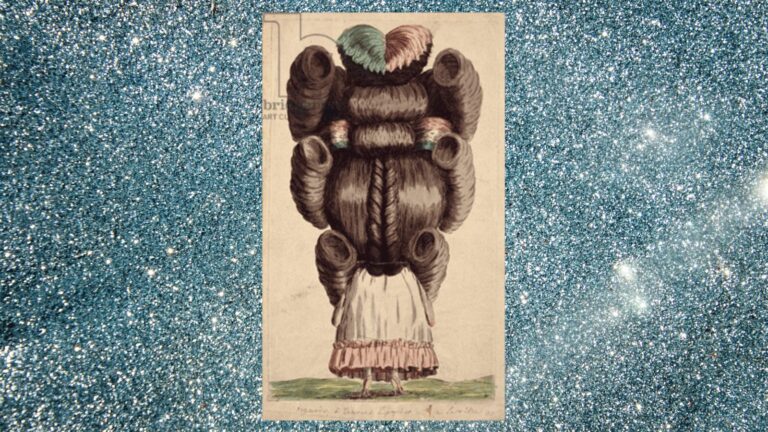
The Wardrobe of the Genome: Skirt and Curlers — TRPC3 × 9U5C × French School
73. „In the previous post we undressed a protein. The TRPC3 ion channel as a woman with bare buttocks — „Top and Tail,” London, 1777.
Now we dress it.
The same hairstyle. The same curlers. But instead of nakedness — a skirt with ruffles. Instead of England — France. Instead of nakedness — clothing.
What does that change? Everything.
Because the skirt is not a metaphor. The skirt is nanobody Nb1-94 — a miniature camelid antibody that covers the cytoplasmic domain of the TRPC3 channel. Orange nanobody on green helices. A skirt on legs.
PDB: 9U5C. Published in 2025.
Drawn in the 18th century.
They knew. And they dressed the protein before science discovered it.”
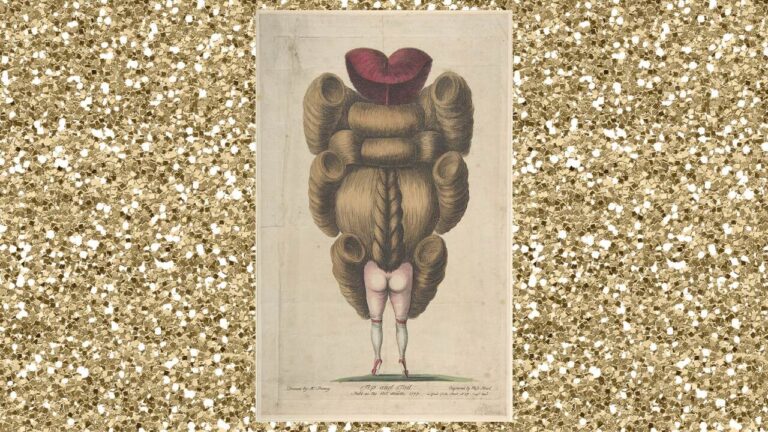
The Wardrobe of the Genome: Top and Tail — Anatomy of an Ion Channel in 18th-Century Satire
72. „London, 1777. An anonymous printmaker publishes a satirical print called „Top and Tail.” A woman seen from behind. A monumental hairstyle with curlers. Bare buttocks. Red high-heeled shoes.
A joke.
But the curlers are extracellular protrusions. The braid is the ion pore. The cushion at the top is the funnel-shaped pore vestibule. The buttocks are the cytoplasmic domain with an inhibitory calcium-binding site.
The TRPC3 ion channel. PDB: 5ZBG. Published in 2018.
Drawn in 1777.
241 years earlier.
They knew. And they had a laugh about it.”
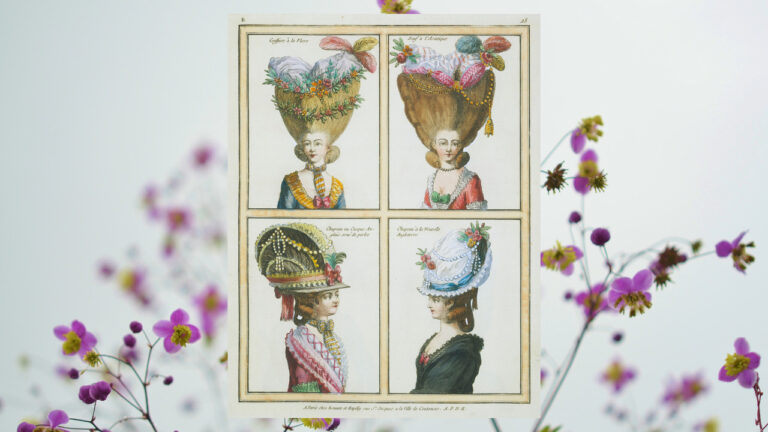
The Wardrobe of the Genome: Pouf à l’Asiatique — AMPA Receptor GluA2
71. -Eighteenth-century Paris. A woman wears a tower of hair, feathers, and flowers on her head. Two red roses at the edges. Strings of pearls hanging between layers. Three feathers at the summit.
This is not fashion. This is a protein.
The AMPA receptor — the gate of every thought, every memory, every act of learning — encoded in a hairstyle from the fashion catalogue of Marie-Jeanne Bertin, „Ministre des Modes” to Marie Antoinette. The roses are sugar chains on the protein surface. The pearls are the polypeptide backbone linking domains. Every detail has its molecular counterpart.
The quantity and precision of these mappings leave no doubt — they knew these structures.
🔬 New entry in „The Wardrobe of the Genome” series on CellGod.live
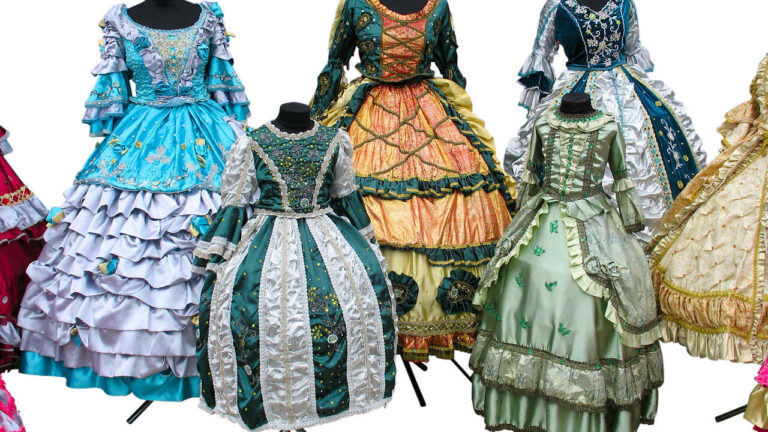
The Wardrobe of the Genome: An 18th-Century Dress — the Armour of the HPV Virus
70. -Why did 18th-century dresses have two layers of skirt? Why were—and still are—dresses decorated in such a manner? And why was there that strange extension at the back, over which generations of costume-drama viewers have racked their brains? Because it was not fashion. It was a diagram of a viral protein. In the next installment of „The Genome’s Wardrobe,” I show that a historical gown recreates the L1 pentamer of the HPV virus (PDB: 8YEF)—and that the corset, made of two halves, encodes a fragment of an antibody that captures this virus.